Series Insight into Green Building & Energy Efficiency Building – Part 2
Table of Contents
Re-evaluating the gap between the title and reality.
In discussions on sustainable development in Vietnam, “Green Building” (GB) seems to have become a universal buzzword. However, the market is witnessing a significant discrepancy: while developers are busy chasing trend-driven green certifications, international climate finance funds are solely setting their sights on Energy-Efficient Buildings (EEB). The difference here lies not simply in the name, but in the core nature of the investment and operational philosophy.
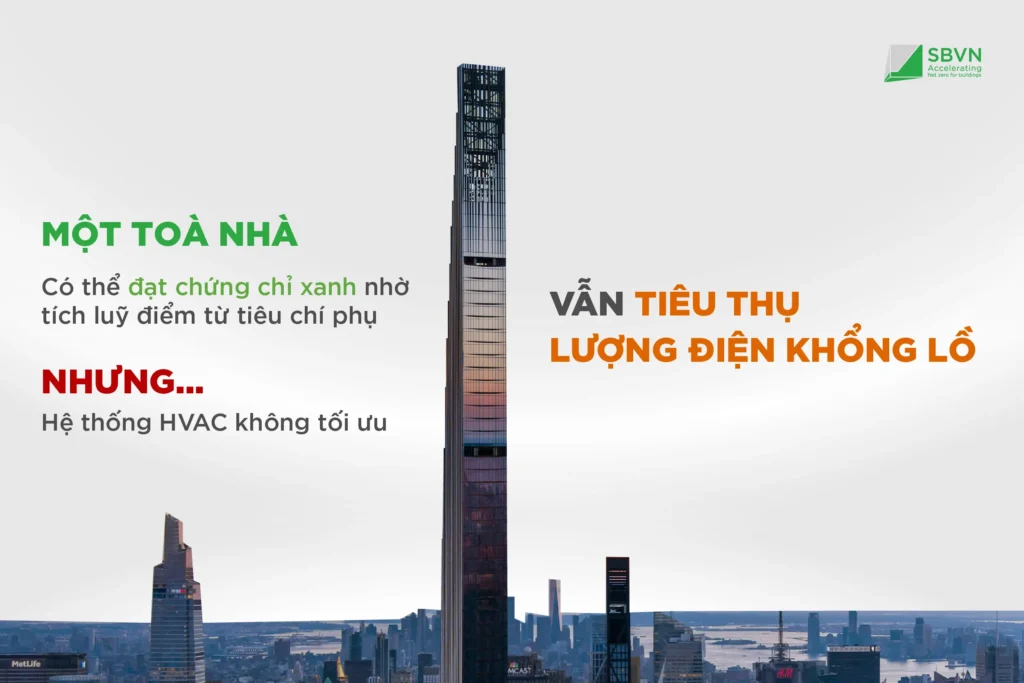
According to the SBVN report (December 2024), 100% of respondents equate sustainable construction with achieving green certifications. Very few clearly understand energy-efficient design or the role of building simulation. In reality, a building can easily achieve a green certification by accumulating points from recycled materials, planting numerous trees, or installing bicycle parking, but the HVAC system is still designed with oversized capacity, resulting in the consumption of a massive amount of electricity every month.

Illustraion: SBVN
In the current market, there are Grade A office buildings in Ho Chi Minh City whose exterior facades are entirely fully cladded with glass. To achieve a green certification, developers choose to compensate for points by using recycled materials in the lobby, planting many trees on the roof, and creating bicycle parking. However, because the glass envelope absorbs too much heat, the air conditioning system has to run constantly at full capacity. The result is a building bearing the “green” title but consuming an enormous amount of electricity each month, completely contradicting the essence of environmental protection.
The discrepancy between the “green title” and actual operational performance is not only a technical issue but also poses a major risk to the transparency and reliability of the market. When buildings carry a green label but fail to prove energy savings or emission reductions in reality, the concept of sustainable development is easily misinterpreted and equated with superficial values. This is also the crucial intersection between the domestic market narrative and the standards of international capital flows – where the distinct difference between Green Buildings and Energy-Efficient Buildings begins to be more clearly examined, and simultaneously, the concept of Greenwash is raised: which buildings truly optimize performance and reduce emissions, and which are merely a superficial “green” shell?
Illustraion: SBVN
What is Greenwash and where is the international capital flowing?
International investment funds (such as IFC, ADB,…) do not disburse capital simply to fund a title. Their core objective is to reduce greenhouse gas emissions in a substantive manner. According to the Global Status Report for Buildings and Construction by UNEP, the building construction and operations sector currently accounts for nearly 40% of global CO2 emissions. Therefore, international green capital exclusively focuses on buildings capable of clearly proving their energy-saving and emission-reduction efficiency, rather than values of a superficial nature.
The focal point of these investments are energy-efficient buildings, where efficiency is measured by actual impact. This is demonstrated through the reduction of electricity and water consumption thanks to passive design solutions and optimal MEP systems. The outcomes do not stop at theoretical evaluation indices but are verified by operational data such as kWh/m²/year and monthly energy bills.
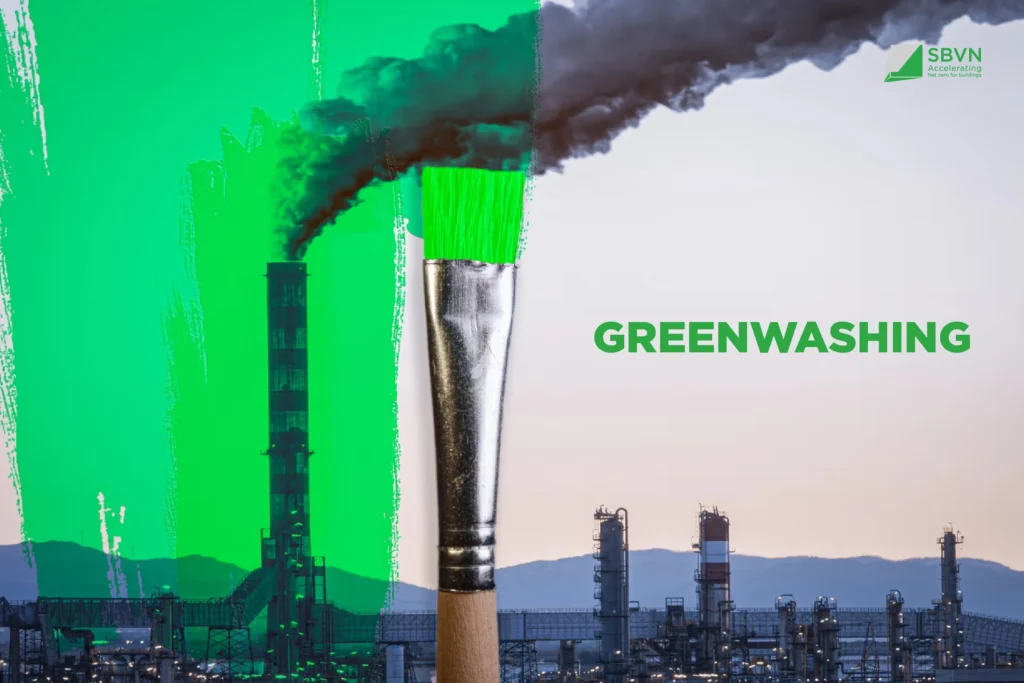
Concurrently, international policies place special emphasis on preventing Greenwashing risks. In the real estate sector, Greenwashing refers to developers making false or exaggerated claims about the environmental value of a project to serve communication purposes. These buildings typically only feature a “green shell” such as abundant greenery or holding basic certifications, but practically still consume a lot of energy and have high emissions during operation.
Illustraion: SBVN
To control this risk, organizations like IFC – World Bank, when providing capital through the EDGE certification, do not evaluate based on superficial elements. Instead, they require projects to prove via technical data that the building achieves a minimum of 20% savings in energy, water, and embodied energy in materials compared to a conventional building. More importantly, these savings levels must be verified during the operational phase through actual data, rather than just stopping at calculation models or scores on paper.
It is this rigorous requirement for measurement and transparency that ensures green capital is allocated to the right targets, contributing to the promotion of truly efficient buildings, instead of projects that are only “green” in name.
The barriers in pursuing energy-efficient building projects.
So what are the reasons why, even with a certain level of interest, the number of projects focusing on energy in Vietnam remains “a trickle”? Breaking down the issue, the SBVN survey identifies 3 hindering barriers:
- The cost paradox: Developers are highly sensitive to the risks of CAPEX increase and schedule pressure. They are willing to spend on easily visible, sales-oriented elements such as landscaping and glamorous facades, but cut back on decisive “behind-the-scenes” components like the MEP system and energy-efficient building envelope designs.
- Fear of new technology risks: The application of energy simulation still creates skepticism for many involved parties. A Viettel representative shared that contractors often do not completely trust simulation results, but rather follow experience and doubt one another; the issue of trust among parties is a major barrier. Consequently, engineers often opt for oversized design approaches to be safe. Developers also worry that optimizing energy might slow down approvals, or cause conflicts with Fire Prevention and Fighting (FPF) requirements.
- Architectural and MEP teams are often under schedule pressure, lacking the time to research new solutions, and simultaneously finding it difficult to locate domestic consulting firms with deep expertise in EEB. On a broader level, the market is lacking a dual driving force: End-users do not yet consider climate change and energy efficiency as sufficiently urgent issues to accept paying extra. The new legal framework stops at the level of encouragement, and is not yet mandatory and stringent like FPF. Actual solution: Energy optimization through simulation and standard consulting
Practical solution: Energy optimization through simulation and standard consulting
To truly achieve energy efficiency standards and access international capital flows, developers need to change their approach: investing in technical analysis steps right from the early stages. Among these, building energy simulation is an indispensable step.
However, for simulation to deliver real value, selecting the right consulting firm right from the conceptual design stage is the decisive factor. A good consulting firm does not merely stop at running software, but must also know how to analyze data to propose appropriate architectural and technical solutions. This process encompasses evaluating sun and wind directions; distributing functional spaces; calculating the wall-to-window ratio; as well as designing optimal mechanical and electrical systems.
In reality, many developers still hold the misconception that an energy-efficient building always comes with high costs. But if the analysis is conducted correctly, investment costs can absolutely be significantly optimized. Instead of choosing expensive solutions such as completely wrapping the building in premium Low-E glass and installing a large-capacity air conditioning system, a competent consulting firm will furnish smarter alternatives, for example: Rotating the building’s axis by a certain number of degrees to avoid the Western sun, using low-cost concrete sunshading louvers and reducing the glass ratio to a lower level. Selecting suitable building materials for each area instead of necessarily choosing the most expensive types. Consequently, this helps save on the investment costs of the air conditioning system, ensures unhindered fresh air flow, and guarantees sufficient natural light without the need to turn on too many lights. Simultaneously, it reduces investment costs and reduces long-term operational costs without needing to depend on expensive materials.

Illustraion: SBVN
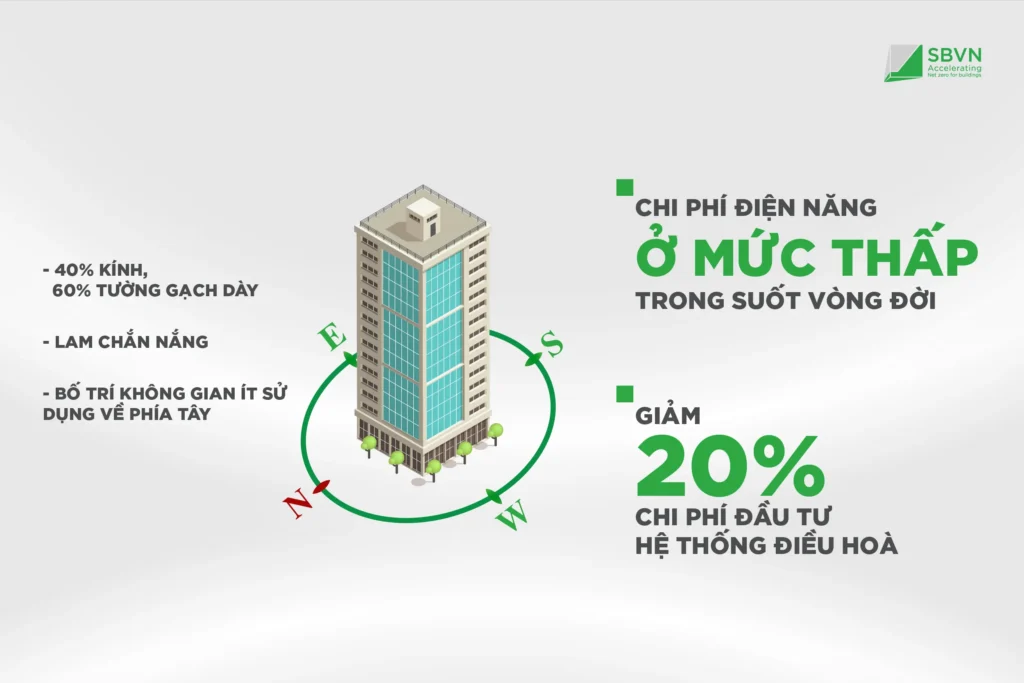
Suppose an office project in Hanoi has its main facade facing West. Initially, the proposed design solution suggests using entirely premium double-glazed glass for heat insulation, which entails the requirement to install a massive-capacity air conditioning system. If there is the involvement of an experienced energy consulting firm, they will use simulation to prove that this solution is not optimal in terms of cost. Instead, passive design solutions will be proposed:
- Reduce the Western glass ratio to about 40%, the remainder uses thick brick walls with thermal insulation layers
- Incorporate sunshading louver systems made of concrete or aluminum at a significantly lower cost
- Arrange less frequently used spaces such as elevator cores and restrooms toward the West to create a natural thermal buffer zone
Illustraion: SBVN
Thanks to these analyses, the heat transfer into the building is effectively controlled. The developer not only saves on the cost of glass materials but also reduces the air conditioning system investment cost by approximately 20%, while maintaining electricity costs at a low level throughout the operational lifecycle. This is a clear testament to the fact: energy efficiency does not come from choosing the most expensive solution, but comes from choosing the right solution based on accurate analytical data.
Conclusion
The transition from formalistic Green Buildings to genuinely Energy-Efficient Buildings is essentially a shift in investment mindset and technical approaches. When design decisions are guided by data, simulation, and in-depth analysis, the efficiency is not only reflected in the reduction of energy consumption but also directly reflects into the financial equation of the project.
For Vietnamese enterprises, accessing international green capital no longer depends on titles or superficial certificates, but lies in the ability to prove practical efficiency. This requires the early involvement of competent consulting firms, along with the integration of technical tools like energy simulation into the design process right from the start. When done correctly right from the initial step, energy efficiency is no longer an additional cost, but becomes an investment optimization tool – simultaneously reducing the initial capital expenditure (CAPEX), optimizing operational expenditure (OPEX), and creating a sustainable foundation for the entire building lifecycle.