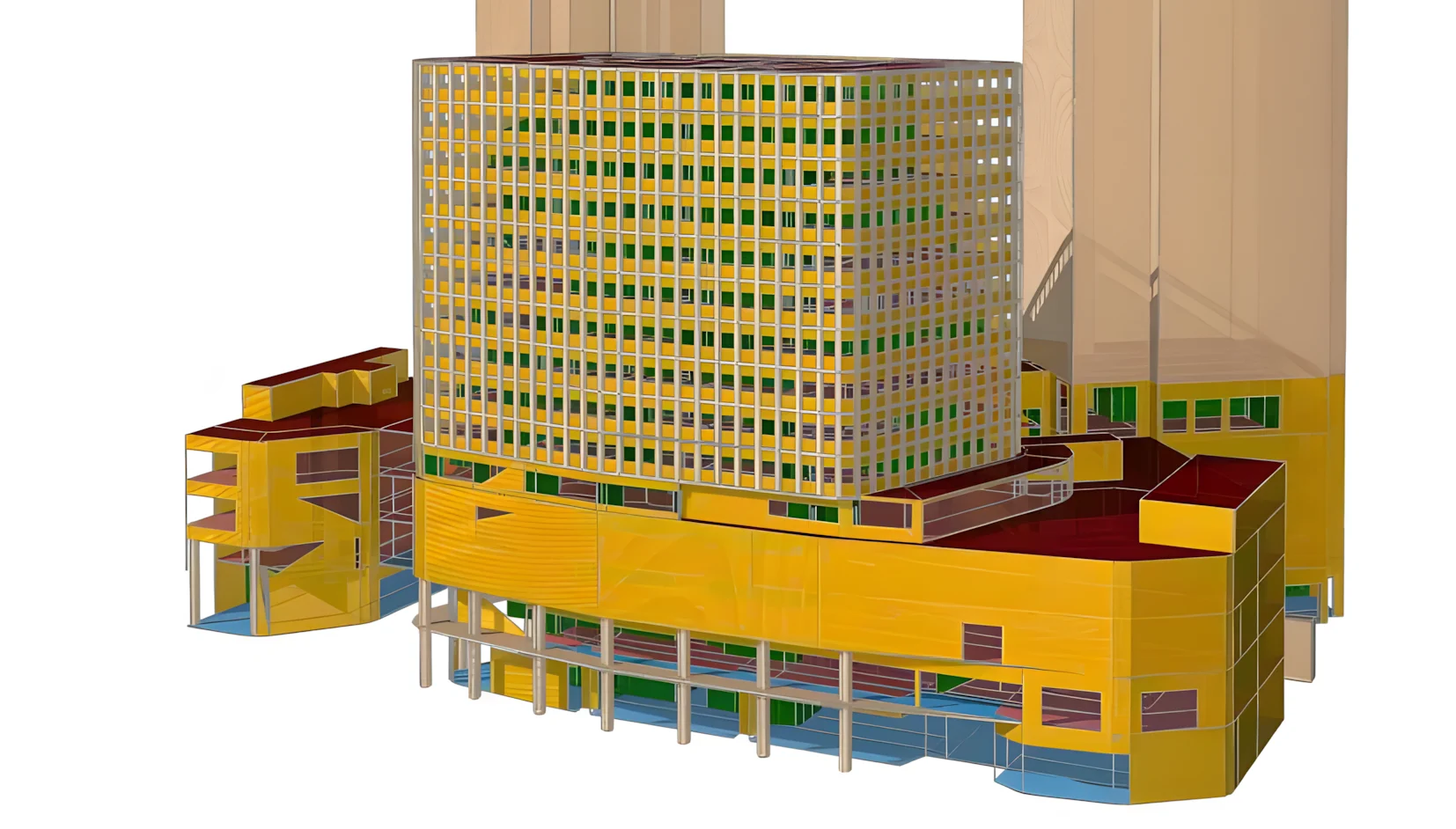
As part of SBVN’s in-depth technical analysis series, Showcase #7 continues to explore a real-world case study on energy design optimization for an existing building. Through Building Energy Modeling (BEM) and the analysis of actual operational data, SBVN conducted a comprehensive assessment of the building’s current performance, identified key sources of energy consumption, and developed an optimized retrofit roadmap.
This case study demonstrates how a data-driven approach enables building owners to balance energy performance, capital expenditure (CAPEX), operating expenditure (OPEX), and payback period, ultimately supporting informed retrofit decisions that deliver long-term sustainable value.
1. General Project Information
- Project: Office and commercial services building
- Location: Hanoi
- Project Target: Reduce HVAC operating energy costs while maintaining thermal comfort for occupants and optimizing retrofit investment costs.
- Scope of Work: SBVN conducted a comprehensive assessment of retrofit opportunities and utilized Building Energy Modeling to optimize the building’s energy performance.
2. Key issues to note at the time SBVN received the project documentation
Through analysis of actual energy consumption data and calibration against the energy simulation model, SBVN identified three major factors affecting the building’s energy performance:
- Underloaded Chiller Plant Operation: The existing cooling system consists of six air-cooled chillers (1,150 kW per unit) serving both the retail and office areas. Operational records indicate that the actual cooling demand is significantly lower than the original design load, with only three to four chillers typically operating during peak periods. Simulation results show that the building’s total annual energy consumption is approximately 7,372 MWh, with the chiller plant accounting for the largest share of electricity usage.
- Absence of Energy Recovery Ventilation (ERV): The office ventilation system is currently not equipped with an energy recovery system. As a result, cooling energy contained in the exhaust air stream is wasted, while the HVAC system must consume additional energy to directly condition outdoor fresh air, increasing the building’s overall cooling load.
- Internal Heat Gains from Office Equipment: Most of the office area (~16,600 m²) currently utilizes desktop computers with an average power demand of approximately 80 W per workstation. These devices not only consume a significant amount of electricity directly but also generate substantial internal heat gains, requiring the air-conditioning system to operate at higher capacity to maintain indoor temperature setpoints.
3. Opportunities to improve the project’s energy efficiency while reducing investment costs
Based on the calibrated energy model, SBVN evaluated multiple retrofit scenarios and proposed four technical solutions:
- Building Façade Optimization: The existing façade system utilizes glazing with a Shading Coefficient (SC) of 0.79 on the ground floor and SC 0.43 (equivalent to SHGC 0.37) on the upper floors. Simulation results indicate that replacing the entire façade with high-performance glazing featuring SHGC 0.22 would reduce total building energy consumption by only 2.0% (approximately 150 MWh annually). Given the relatively limited energy savings and insufficient economic return, SBVN recommends retaining the existing glazing system to achieve an optimal balance between operational performance and investment efficiency.
- Installation of Energy Recovery Ventilation (ERV): SBVN proposes upgrading the existing Primary Air Units (PAUs) serving office areas into heat recovery PAUs. The system utilizes the cooling energy contained in exhaust air to pre-condition incoming outdoor air before supplying it indoors, while maintaining Indoor Air Quality (IAQ) in accordance with applicable standards.
- Replacement of Air-Cooled Chillers with Water-Cooled Chillers: To improve cooling system efficiency, SBVN recommends replacing four existing air-cooled chillers with two high-efficiency water-cooled chillers (2,200 kW per unit). Water-cooled chillers provide a significantly higher Coefficient of Performance (COP) compared with air-cooled chillers. The remaining two air-cooled chillers would be retained for operation during winter conditions or periods of low cooling demand.
- Office Equipment Upgrade Strategy: SBVN recommends collaborating with tenants to replace 80% of desktop computers (80 W/unit) with laptop computers (20–25 W/unit) in areas that do not require high-performance computing capability. This measure reduces direct electricity consumption while simultaneously lowering internal heat gains imposed on the HVAC system.
4. Economic and technical results of the proposed solutions
- Operational Energy Savings:
- Approximately 170 MWh of electricity savings through workstation replacement (assuming 80% laptop adoption) in office spaces without high-performance computing requirements.
- Total building energy consumption reduced by 1,578.6 MWh annually.
- Chiller energy consumption reduced by 1,658.9 MWh annually.
- PAU heat recovery upgrade contributes an additional reduction of 502.9 MWh annually.

Figure 1: High-efficiency heat recovery installation option
- Operating Cost Savings:
- Estimated annual savings of VND 5.4 billion VND through chiller replacement.
- Additional annual savings of VND 1.7 billion VND through upgrading office ventilation systems to heat recovery PAUs.

Figure 2: Chiller replacement options
- When all recommended measures are implemented simultaneously, simulation results indicate a total reduction of approximately 1,897 MWh/year, equivalent to annual operating cost savings of approximately 6.53 billion VND.
- The estimated investment cost for the new chiller plant ranges from VND 13–18 billion. However, the upgrade significantly improves overall operational efficiency and shortens the simple payback period to approximately 3–4 years. The project may also be implemented through Energy Service Company (ESCO) financing models or Green Finance mechanisms, depending on the owner’s investment strategy.
5. Conclusion

Figure 3: In the case of combining all three key options
By implementing the optimal combination of Option 3 and Option 4, the project is projected to achieve operating cost savings exceeding VND 6.5 billion annually while reducing greenhouse gas emissions by approximately 1,100 tons of CO₂ per year.
The estimated Capital Expenditure (CAPEX) for chiller replacement ranges from VND 13–18 billion. Based on the projected energy savings, the Return on Investment (ROI) is estimated at approximately 3–4 years. In addition, the Owner may consider Green Finance opportunities or Energy Service Company (ESCO) partnerships to optimize initial capital requirements.
The application of Building Energy Modeling (BEM) to existing buildings provides an accurate, data-driven basis for decision-making. This approach supports strategic retrofit planning, optimizes investment allocation, and enhances the long-term sustainability and operational performance of the building.