
Overview
In Hungary, final energy consumption has increased from 15.8 Mtoe to 18.0 Mtoe, i.e by 14% between 2000 and 2022. The residential sector has the biggest share, but its part has somewhat decreased over time (-3.4 percentage points to 33% in 2022). Transport is the second largest sector and its share has rapidly grown from 19% to 29.4% (+10.4 pp) between 2000 and 2022. However, it is still well below the EU average of 31% in 2022. Industry is ranking third with the rise of 2.7 pp point over the given period. The share of services has significantly decreased since 2000, while the share of agriculture also decreased slightly (from 4.2% to 3.1%).
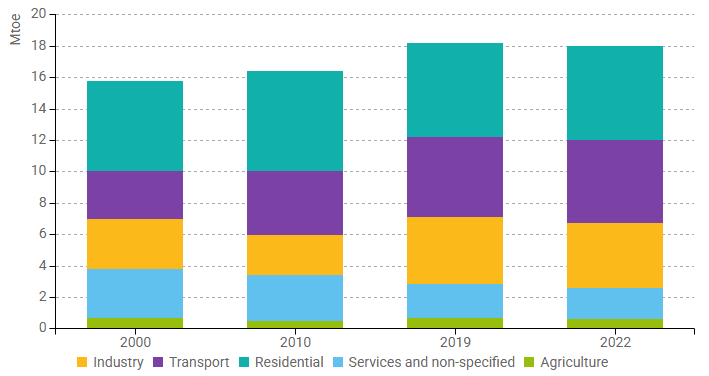
Figure 1: Final energy consumption by sector (with climatic corrections)
Energy efficiency, measured by ODEX has improved annually by 1.3%/year from 2000 to 2022, i.e. by 25% over the entire period. The most significant improvement occurred in the services sector (52% or 3.3% on average per year) and in the industry sector (38% or 2.1%/year), while only a lower development can be seen in the residential sector (16% or 0.8%/year) and the transport sector (0.2%/year).
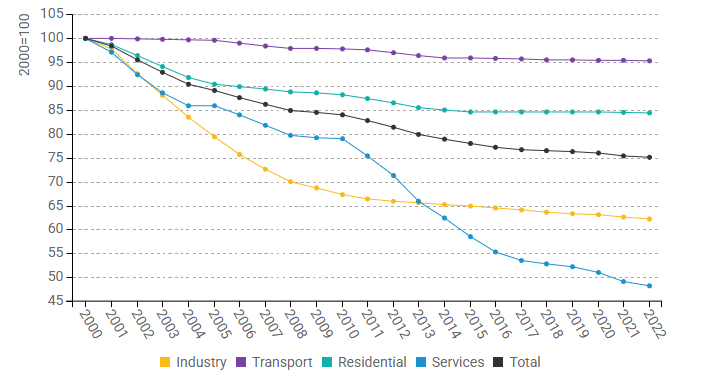
Figure 2: Technical Energy Efficiency Index
Hungary’s main energy efficiency target is that the country’s final energy consumption in 2030 does not exceed 740 PJ. We are looking at the feasibility of the indicative cumulative energy savings target of 484.6 PJ set in the new Energy Efficiency Directive, which could be achieved by a reduction of 126 PJ in final energy by 2030.To achieve these, Hungary has introduced EEOS, which was introduced in 2021 for electricity, natural gas and transport fuel sector. The rate of end-use energy savings in 2021-2030 is expected to achieve 0.8% per year compared to the average final energy consumption in 2016-2018 period. The most important energy efficiency measures are non- or partly refundable support schemes, outlined in the Operational Programmes (OPs), financed by EU Funds. The focus of the 5th priority axis of the Environmental and Energy Efficiency Operative Programme (KEHOP) is explicitly the improvement of energy efficiency. The TOP programme finances energy efficiency upgrades at local authorities. The GINOP programme has also sub-programmes that aim to promote energy efficiency in the enterprise sector. The various OPs target a wide range of consumer groups. Hungary is committed to allocating significant amount of RRF resource to energy efficiency and renewable energy improvements.
| Measures | Description | Expected savings, impact evaluation |
|---|---|---|
| Energy Efficiency Obligation Scheme | The EEOS imposes energy saving obligations on obligated parties, i.e. those natural gas and power traders, universal service providers and fuel distributors that provide energy to end-users. Obligated parties shall implement specific programmes and measures that result in verified energy savings for the end-user. The energy auditing organisations have the competence to validate the energy savings, open an account for the beneficiary of the energy savings and initiate the recording of validated energy savings in the register kept by Hungarian Energy and Public Utility Regulatory Authority (MEKH). The registered energy savings may be transferred by bilateral agreement or on an organised market, but exclusively to one of the obligated parties. | 3.73 PJ |
| Modern Cities Program (Modern Városok Program) | Modern Cities Program (Modern Városok Program) is a development program for cities with county rights in Hungary. | 0.75 PJ |
| EU-related: Regulation on the governance of the energy union and climate action (EU) 2018/1999 – National Energy Strategy 2030 | The new National Energy Strategy 2030 adapted in 2020 sets four priorities for Hungary. It places consumers at the heart of the strategy, aims to improve security of supply, to perform a clime-friendly transition of the energy sector and to exploit economic development opportunities stemming from energy innovation. | 2.25 PJ |
| Promotion of energy efficient management of public buildings (Energiamegtakarítási intézkedési terv közintézményeknek) | Energy efficient management of public buildings is promoted through the requirement of preparing an energy saving action plan every 5 years, and report about implementation to the National Network of Energy Managers. | 0.75 PJ |
Buildings
Space heating accounted for 72% of final energy consumption of households in 2022, which is 8% points higher than the EU average. Nevertheless, there is a decreasing trend in energy consumption of space heating per m2 visible in the last ten years (-1.5%/year since 2012). Overall, it has decreased by 6.4% between 2000 and 2022, because of the lower growth rate of households heating energy consumption compared to the increase of occupied dwelling area size. There is a significant decrease visible in 2022 (-6.5%), due to the energy crisis.

Figure 3: Energy consumption of household space heating per m2 (with climatic corrections)
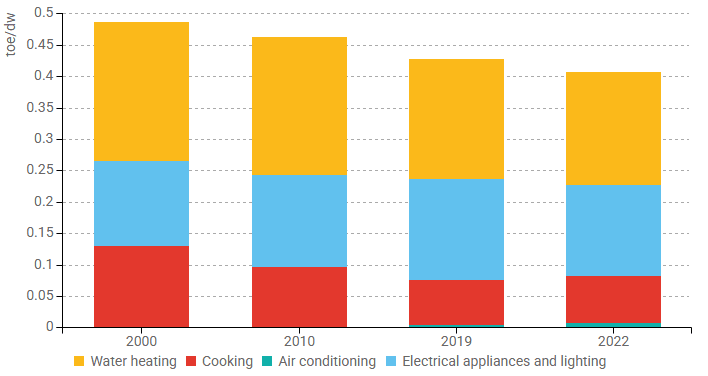
Figure 4: Energy consumption per dwelling by end-use (except space heating)
Energy consumption in the household sector increased by 3.9% from 2000 to 2022 (+0.22 Mtoe). The main driving forces behind the consumption variation have been the increase in the stock of household appliances (+1.44 Mtoe), in the average size of homes (+0.6 Mtoe) and in the number of dwellings (0.43 Mtoe). On the other hand, energy savings, have contributed to lower the consumption by 1.05 Mtoe. A decrease of 1.23 Mtoe of the consumption was the result of changes in consumer behaviour, changes in fuel mix and other unknown effects and data problems.
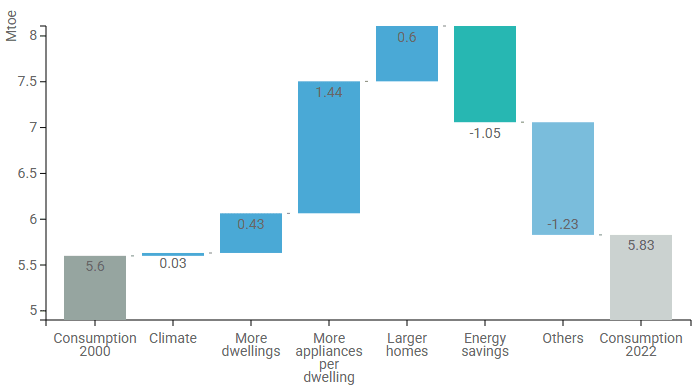
Figure 5: Main drivers of the energy consumption variation in households
Due to a diffusion of electrical appliances in offices an increasing trend of electricity consumption can be observed over the period 2000-2010. There was a data revision in 2012, which explains the large variation in 2012. Since 2012, a slight efficiency improvement is observed (3.6%/year in total energy consumption per employee and 1.7%/year for electricity between 2012 and 2022).
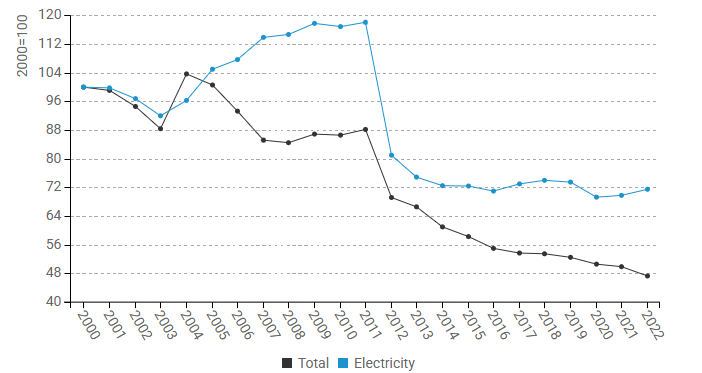
Figure 6: Energy and electricity consumption per employee in services (with climatic corrections)
The 2002/91/EC directive (EPBD) was implemented in Hungary by the 7/2006 (V.24.) TNM Decree and the 176/2008 (VI.30.) Governmental Decree. In 2008, a building certification scheme was introduced. Due to the new regulations, technical heat requirements became 30% stricter than before. The recast directive of 2010/31/EU introduced stricter requirements that were implemented through several amendments of the TNM decree. An important amendment of the decree in 2014 made the cost-optimal energy efficient requirement a pre-condition for obtaining funding from either state budget or EU funds. TNM decree was further amended with effect from 2021. All new-construction buildings to be commissioned after 30 June 2024 must comply with the requirements of Annex 6 (nearly zero-energy buildings). From November 2023, the TNM decree became null and void and was replaced by the 9/2023 (V.25.) ÉKM decree. On 1 January 2021 the government launched a scheme for subsidising home renovations carried out by households with at least one child. Half of the renovation costs up to a maximum of HUF 3 million per renovation will be covered by the state.
| Measures | Description | Expected savings, impact evaluation |
|---|---|---|
| Green Preferential Capital Requirement Programme (Zöld Tőkekövetelmény-kedvezmény Program) | Hungarian National Bank announced a preferential capital requirement programme for credit institutions to support the growth of green financial products and to improve the energy efficiency of the Hungarian building stock. | 0.27 PJ |
| Scheme for subsidising home renovations carried out by households with at least one child | The tender was created to fulfil the objectives of the Climate and Nature Protection Action Plan which was approved by the Hungarian government in 2020. The aim of the tender is to provide an alternative to the use of motor vehicles and to reduce the use of fossil fuels, and thus the air pollution of the given settlement. | 1.34 PJ |
| Residential loan scheme for energy efficiency and renewable energy based modernizations of the building stock | This measure was launched in 2017 to trigger renovations that made buildings more energy efficient. Free loans are financed by EU funds so that low-income are also able to modernize their buildings. Claiming those funds comes with mandatory use, e.g. thermal insulation, heating/cooling system modernisation etc. The funds are foreseen to be sufficient for 25 000 – 30 000 households. | 0.27 PJ |