
Overview
In 2022 final energy consumption (FEC) in Latvia was 3.8 Mtoe, which represents an increase of 16% compared to 2000. In 2022, the largest consuming sector is residential, 29% of total FEC. Unlike other sectors, residential energy consumption decreased by 19% over this period, and its share has decreased by 12.6 percentage points. The share of transport has significantly increased from 22% to 27% in 2022, while industry increased its share from 17.5% to 23.9%.. Due to change in the geopolitical situation in 2022 and the associated rapid increase in energy prices, significant decline in energy consumption was observed in several sectors and in total in 2022 (- 3.4% compared to 2021).

Figure 1: Final energy consumption by sector (with climatic corrections)
Energy efficiency for final consumers, as measured by ODEX, improved by 31%, or 1.7% per year from 2000 to 2022.The rate of improvement slightly decreased (1.3% per year since 2010, compared to 2.1% per year over 2000–2010). In industry, despite the economic recession (2008-2011), there has been steady progress and larger gains than in the other sectors, 45% (2.7%/year). Financial support programmes and legislation targeted at reducing heat losses from buildings had contributed to energy efficiency improvement in residential sector by about 36% (average 2.0%/year). For transport and service sectors, gains are lower (respectively 1.3% and 0.5% per year since 2000).

Figure 2: Technical Energy Efficiency Index
Estimated total energy savings from 2000 to 2022 are around 1.4 Mtoe. Household sector played major role, contributing nearly half (44%) of them. The second largest contribution is provided by industry (31%), followed by transport sector (20%). If in households and industry these savings had been generated due to implemented energy efficiency support programmes and market-based technology development trends, the savings in transport sector had mainly been generated by technological development and, to a lesser extent, by support programmes. Rapid increase in energy prices in 2022 significantly affected consumer behaviour. Energy savings in household and services in 2022 increased by respectively 10.3% and 16.7% compared to 2021.
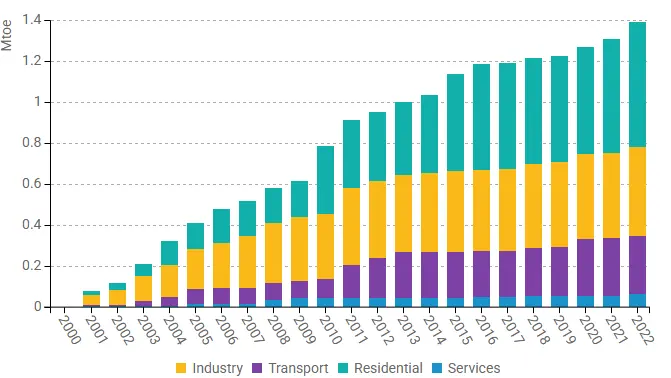
Figure 3: Energy savings by sector
Between 2000 and 2022 primary energy consumption of Latvia increased by 0.4 Mtoe (almost 10%), from 3.84 to 4.23 Mtoe). The increase in final demand (0.59 Mtoe) was partly offset by a lower consumption in the power sector (mainly due to introduction of the efficient CHP technologies and lesser extent switching to renewable energy sources), which accounted for a decrease of 0.15 Mtoe. Compared to these effects, the contributions from energy use in other transformational changes and non-energy use were relatively small.
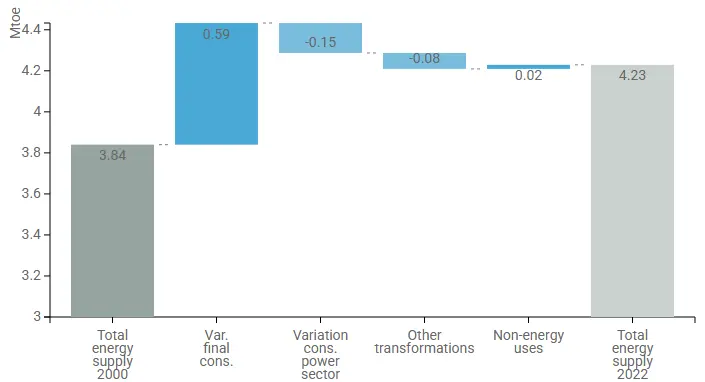
Figure 4: Main drivers of the total energy supply variation
During the period 2000-2022, total final energy consumption in Latvia increased by almost 0.6 Mtoe (from 3.23 to 3.83 Mtoe). The economic activity and structural changes, as well as the weather fluctuations contributed to a total increase of final energy consumption by around 2.24 Mtoe, with the activity effect being the main driver with a share of 82% (+1.83 Mtoe). These were, however, compensated by the energy savings achieved through a considerable improvement in energy efficiency (1.39 Mtoe) as measured by the ODEX and, to a lesser extent, other effects mostly behaviours) that also caused decreasing energy consumption over the period 2000-2022.

Figure 5: Main drivers of the final energy consumption variation
Energy efficiency improvement is one of the top priorities of national energy sector development which allows for the cost-effective reduction of risks associated with security of energy supply, provides sustainability, competitiveness and growth of national economy, in line with GHG emissions mitigation. Mix of instruments are used for energy efficiency policy implementation. The co-financing of energy efficiency investments (see sectorial Tables) and obligation to implement energy management systems (EMS) should be particularly underlined. Table below presents EMS implementation by large enterprises and large electricity consumers, for EMS in public bodies see the Buildings section. Latvia’s Updated NECP2030 put special importance to imposement of obligation on public bodies to monitor and reduce energy consumption and to ensure their exemplary role. In line with Article 5 of the new EED 2023/1791/EU, the mandatory target will be set for public sector (including state and municipal capital companies) – 1.9% energy consumption reduction annually. Latvia’s cumulative energy saving target in 2030, according to Article 8 of EED, is 29.5 TWh (2.5 Mtoe). To meet the cumulative energy saving target for 2020, both Energy Efficiency Obligation Scheme (included electricity retail sellers) and alternative measures were implemented. For 2021+ period the EEOS is not continued.
| Measures | Description | Expected savings, impact evaluation |
| Implemented voluntarily by electricity retail sellers energy efficiency measures | For 2021-2030 period the Energy Efficiency Obligation Scheme is not continued. At the same time several electricity retail sellers voluntarily reported on implemented by them energy efficiency promoting measures. Almost all (~97%) savings have been provided by the information and awareness measures focused to particular target groups. The expected savings in 2030 is average savings in 2021 and 2022 due to these voluntarily measures, applying 1-year lifetime. | 1.4 PJ |
| Energy Audits/Energy Management Systems and Energy Efficiency Improvement in Large Enterprises | The large enterprise shall implement energy audit or EMS or supplemented EnvMS and provide annual report on implemented energy efficiency measures and reached savings. At least three energy efficiency measures (or all if one or two stated) stated by the energy audit or EMS which have the highest energy savings or highest economical return shall be implemented by large enterprise. The expected cumulative annual savings in 2030 (2021-2030 period) is the extrapolation of average 2021 and 2022 savings up to 2030. | 1.6 PJ |
| EMS//Energy Audits in Entities – Large Electricity Consumers | Legal entity is considered as Large Electricity Consumer (LEC) if its own annual electricity consumption is above 500 MWh in two subsequent years. LEC shall implement EMS or supplemented EnvMS or energy audit and shall provide annual report on implemented energy efficiency measures and reached savings. At least three energy efficiency measures stated by the energy audit or EMS which have the highest energy savings or highest economical return shall be implemented by LEC. The expected cumulative annual savings in 2030 (2021-2030 period) is the extrapolation of average 2021 and 2022 savings up to 2030. | 1.9 PJ |
Buildings
Total energy consumption in buildings in 2022 was 10% lower than in 2000. Consumption in residential buildings had decreased by 19% during this period. In contrast, consumption in service sector buildings had increased by 16%. Rapid increase in energy prices in 2022 affected energy consumption, which decreased by 5.8% in residential buildings and by 4.6% in service sector buildings, compared 2021.
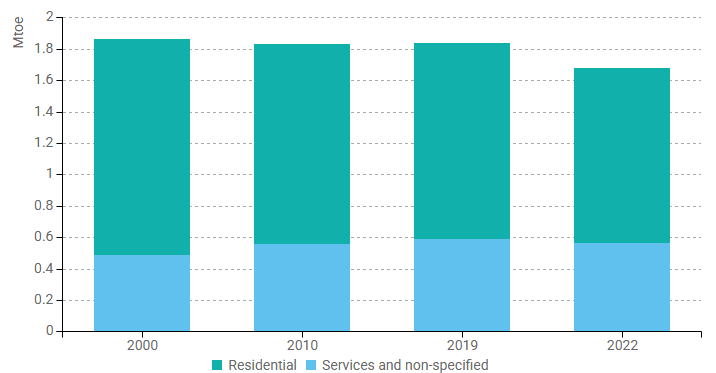
Figure 6: Final energy consumption in buildings (with climatic corrections)
In 2022, space heating accounted for 65% of household consumption, water heating for 19%, cooking for 7% and electrical appliances and lighting for 9%. In 2000-2022, space heating and water heating consumption decreased, respectively by 29% and 13%. Due to buildings energy efficiency improvement space heating consumption decreased fastest, its share decreased by 7.6%. Consumption for appliances and lighting increased by 39% mainly due to increase of large appliances number.

Figure 7: Energy consumption by end-use of households (with climatic corrections)
Household consumption per m² for space heating decreased by 44% (average 2.6%/year) since 2000, from 21.7 koe/m² to 12.1 koe/m² in 2022, thanks in particular to buildings renovation support programmes. Important, unit consumption average value is influenced by several factors partly compensating each other: fuel substitution, higher energy efficiencies due to thermal regulations, changes in heating system (trend to central heating), changes in the share of single and multi-family dwellings and last but not least behavioural factors (e. g. trend to higher or lower indoor temperature). Behavioural factors played a significant role in energy consumption changes in 2016-2018 and 2021-2022.
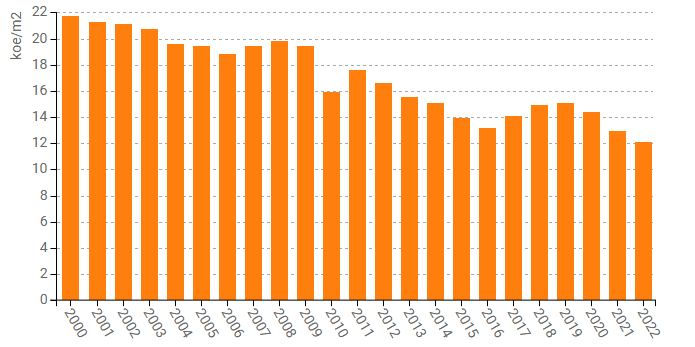
Figure 8: Energy consumption of household space heating per m2 (with climatic corrections)
Total energy consumption per dwelling (excluding space heating) in 2022 was by 7% higher than in 2000. The indicator reached maximum value in 2010 when unit consumption was 28% higher than in 2000. Over time, by 2022, this unit consumption decreased by 16% compared to 2010. Over the entire period consumption for water heating decreased by 8%, in contrast, consumption for electric appliances increased by 48%, mainly due to increase of appliances number. Average value of unit consumption is influenced by several factors partly compensating each other, e.g., dwelling average size, number of people per dwelling, fuel substitution and other.

Figure 9: Energy consumption per dwelling by end-use (except space heating)
Total electricity consumption per dwelling in 2022 was 47% higher than in 2000. Growth is roughly the same for both end-uses. Consumption, related to electric appliances, increased significantly until 2010 due to rapid growth in their number, after 2010 it decreased due to progressively use of more efficient appliances and wider use of LED bulbs for lighting.
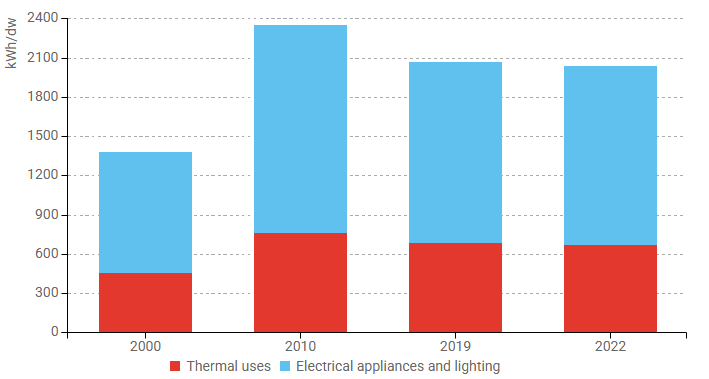
Figure 10: Electricity consumption per dwelling by end-use (with climatic corrections)
In 2022 final energy consumption of households was 0.2 Mtoe lower than in 2000. On the one hand, three main drivers contributed to increase energy consumption – lifestyle/comfort (larger homes by 0.48 Mtoe), more appliances per dwelling (0.26 Mtoe) and climate effects (by 0.06 Mtoe). On the other hand, energy savings (0.61 Mtoe) partly compensated the effect of the above-mentioned energy consumption drivers, while the decline in the number of dwellings had a slight downward impact of 0.08 Mtoe.
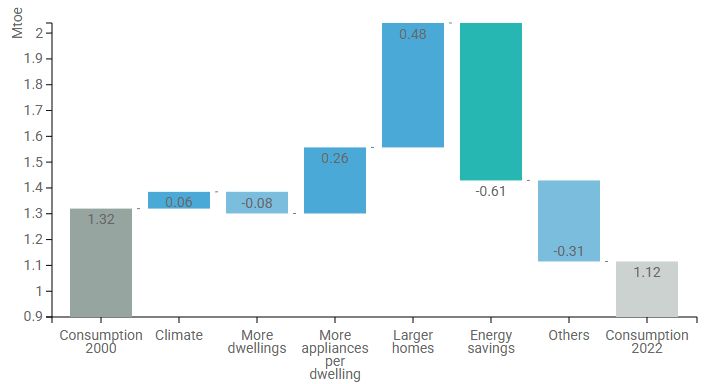
Figure 11: Main drivers of the energy consumption variation in households
Over the period 2000-2022, space hating consumption in the residential sector decreased by around 0.22 Mtoe (from 0.94 to 0.72 Mtoe), mainly due to the energy efficiency improvement (0.54 Mtoe) that exceeded the consumption rise linked to the lifestyle/comfort (larger homes) and penetration of central heating. Climate effects and population change (less dwellings) played less role.
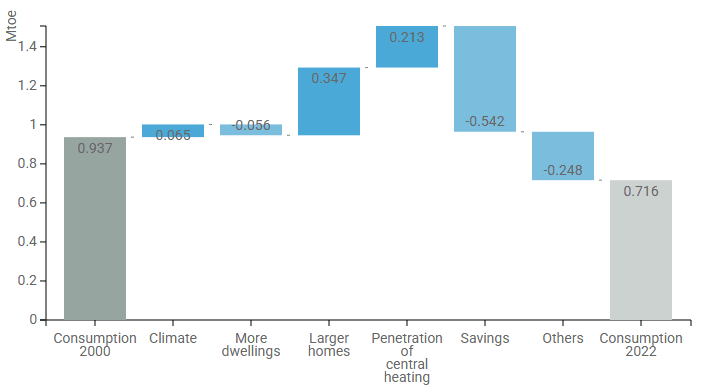
Figure 12: Main drivers of the space heating consumption variation of households
In 2022 final energy consumption of services sector was less by 2% than in 2015. Trend is driven by main branches with the largest share in total consumption in 2022: private offices (36%), public offices (16%), wholesale (15%). All branches perceived consumption decrease, ranging 2-18%, except wholesale. Thanks to support programmes for state and municipal buildings renovation, the consumption of public offices decreased by 18%.
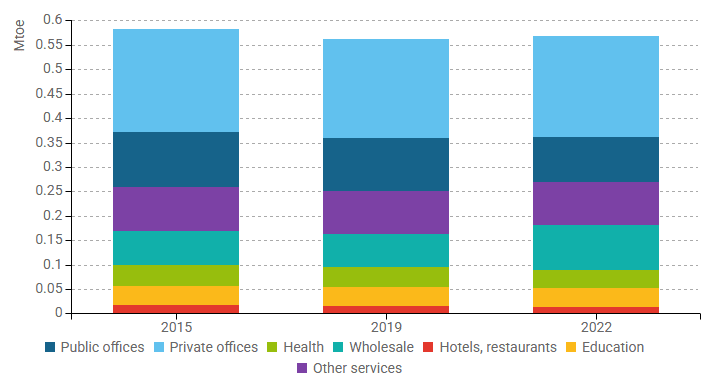
Figure 13: Final energy consumption of services by branch
Energy consumption per employee increased by 8% between 2000 and 2022, mainly due to electricity consumption per employee sharp increase by 61%. Though electrical appliances become ever more efficient, rapid increase in their number and ICT diffusion in offices contributed to this growth. Digital solutions introduction to replace employees in certain segments of service sector also affects this indicator.

Figure 14: Energy and electricity consumption per employee in services (with climatic corrections)
Buildings is one of the top priorities of national energy efficiency policy, particularly emphasized by Updated NECP2030. Mix of investment support, regulation, information and demonstration measures are used. Significant energy saving impact is provided by the obligation to implement energy management systems (EMS) in public sector. Thermal engineering of new apartment building envelopes since 1980 is characterized by continuous stringent regulations, resulting in decrease of specific normative energy consumption for heating: 150-200 (1980), 100-130 (1992), 70-90 (2003), 60-85 (2015), 40-60 (2021) kWh/m2/year. However more than 90% of total floor area of multi-apartment buildings were built before 2003, thus having low energy efficiency. Energy certification of buildings has been introduced in 2013. The recasted Cabinet of Ministers Regulation on Energy Certification of Buildings (2021) states both energy consumption for heating and non-renewable primary energy consumption for particular energy performance classes, also voluntary A+ class is introduced. The new Construction Standard (in force 2020) incorporates directly the energy performance requirements (in kWh per m2 annually). From 01.01.2021 (public buildings from 01.01.2019) all construction intentions are nearly zero energy buildings, if economically viable. In December 2020 the Cabinet of Ministers Regulation on minimal energy efficiency requirements of existing buildings has been adopted.
| Measures | Description | Expected savings, impact evaluation |
| Energy Efficiency Improvement and RES technologies in Multi-Apartment Residential Buildings | Over 2009-2023 period the energy efficiency improvement of multi-apartment buildings had been co-financed by the ERDF, in total around 1.4 thousand buildings had been renovated. The completed in 2021-2023 projects provide in 2023 0.3 PJ cumulative annual savings (see completed HOU-LV0791). In 2023-2029 the energy efficient renovation of residential buildings, including the installation of RES utilising microgeneration technologies (both heat and power production) is continued. The investments are co-financed by two funds: Latvia’s Recovery and Resilience Facility Plan (2023-2026) and Cohesion Policy Programme for 2021-2027planning period (2025-2029). In its turn, the information programme “Let’s Live Warmer!” (see HOU-LV0779) promotes the housing associations participation in the programme by providing information on the best practices of the renovation and available financial support, as well as on the good practice of maintaining the apartment buildings after renovation. The expected savings for the projects to be completed in 2024-2029 period is also 0.3 PJ. | 0.6 PJ |
| RES technologies in Residential Buildings to reduce GHG emissions: national EAAI instrument. | The investment co-financing by revenues from EU ETS Emissions Allowances Auctioning in 2022-2029 is provided for wide range of residential buildings’ types. Support is provided for purchase of RES heat technology to replace existing fossil fuel one, solar heat technology to produce hot water, RES electricity technology to produce, store and supply renewable electricity to residents. Also connection of buildings to district heating system is supported. Energy saving is accounted arising due to installation of heat pumps and effective wood pellets technologies replacing previous low-efficiency heating systems. | 0.2 PJ |
| Energy Management Systems in Municipalities | After 2021 administrative territorial reform the EMS implementation is mandatory in all municipalities. Annual report on implemented energy efficiency measures and reached savings has to be submitted. The expected cumulative annual savings in 2030 (2021-2030 period) is the extrapolation of average 2021 and 2022 savings up to 2030. | 0.4 PJ |
| Energy Efficiency Improvement and RES technologies in State Buildings | The completed in 2021-2024 projects of the previous planning period of 2014-2020 provide in 2024 0.1 PJ cumulative annual savings (see completed SER-LV1706). The measure continues in 2023-2029 the improvement of energy efficiency (both building’s constructions and engineering systems) and providing of smart energy management in buildings of various use: (i) state central administration buildings, (ii) vocational education institutions and colleges (SER-LV4290, (iii) buildings in which the functions related to culture sector is performed (SER-LV1717). The investments are financed by the Latvia’s Cohesion Policy Programme for 2021-2027 planning period as well as by Latvia’s Recovery and Resilience Facility Plan; co-financing by state budget and, in particular buildings, by private financing. The measure includes also installation of RES equipment for heat and power generation, as well as connection to district heating systems. The expected savings for the projects to be completed in 2024-2029 period is 0.1 PJ. | 0.2 PJ |
| Energy Efficiency Improvement and RES technologies in Municipal Buildings | The completed in 2021-2024 projects of the previous planning period of 2014-2020 provide in 2024 0.07 PJ cumulative annual savings (see completed SER-LV1707). The measure continues in 2023-2029 the improvement of energy efficiency (both building’s constructions and engineering systems) and providing of smart energy management in buildings of municipalities, the measure also includes installation of RES equipment for heat and power generation as well as connection to district heating systems. The investments are financed by two funds: Latvia’s Recovery and Resilience Facility Plan and Cohesion Policy Programme for 2021-2027planning period; co-financing by municipalities budget. The expected savings for the projects to be completed in 2024-2029 period is 0.03 PJ. | 0.1 PJ |